

Scottie was digging through my backpack when I first realized I might have made a serious mistake choosing my travel companions.
In one day, we had already lost a Canadian at a gas station, crossed a sketchy international border, and pushed the world’s oldest running Honda Civic into a creek bed while listening to Bonnie Tyler’s Total Eclipse of the Heart.
“What are you looking for?” I asked.
“I left it in your sock.”
He pulled out a bag of weed.
I stared at the bag. Then at Scottie. Then at the backpack I had personally carried past the Nicaraguan border guards.
These days, my wife, Claire, plans our vacations. She makes reservations. She reads reviews. She remembers sunscreen. My main job is to show up and carry our luggage.
Two decades earlier, on my trip to Nicaragua with Eddie, I was also carrying someone else’s baggage. And I wasn’t happy about it.
A four-dollar room in Tamarindo
In 2004, I worked at CNN, where I spent most of my waking hours staring into a computer monitor roughly the size of a washing machine.
CNN gave us 27 days of paid time off a year. Unfortunately, news continued to happen on Christmas, and the people who planned their vacations more than a day in advance got first dibs. One year I only used three days. The other 24 expired.
I had somehow turned paid vacation into an unpaid donation to the Cable News Network.
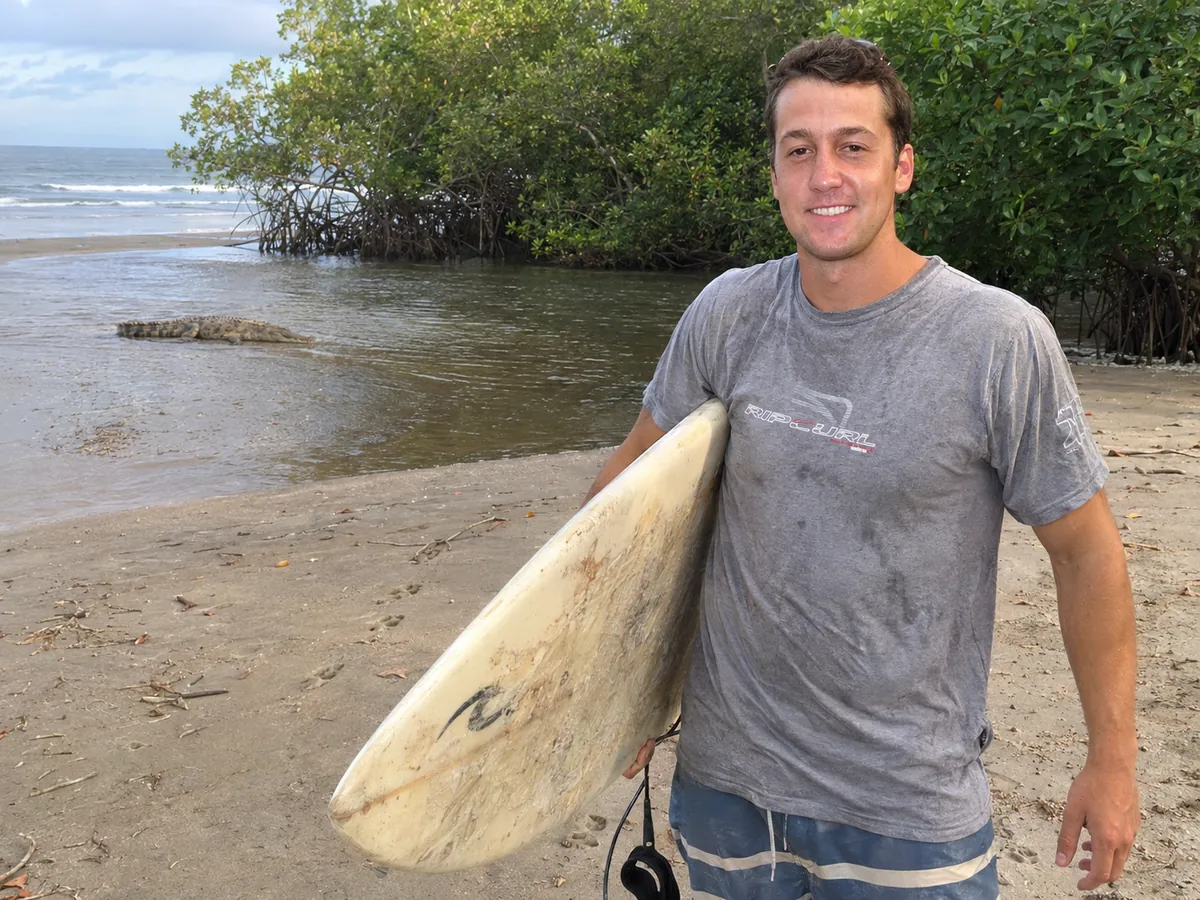
Meanwhile, my friend Eddie was teaching school in Tamarindo, Costa Rica.
This was an unexpected career choice. Eddie was more Gordon Gekko than Ms. Frizzle. I could picture him buying a school. I had a harder time picturing him patiently explaining fractions to its students.
Eddie lived in a four-dollar-a-night hostel and rode a cheap bicycle down a dusty road for an hour to get to work. The four-dollar room was his splurge. There were two-dollar options, and I suspect he strongly considered them.
From my climate-controlled newsroom, Costa Rica sounded magnificent.
During a particularly slow news day, I stumbled across a last-minute flight to Liberia, Costa Rica, for less than it now costs to have DoorDash bring my Chipotle order. The departure time was terrible, and I could take only what fit in a carry-on, but that was fine. My entire vacation wardrobe consisted of cargo shorts and tank tops. I could practically wear my luggage.
I bought the ticket and told Eddie—in that order.
“Got you a room,” he said. “Four bucks.”
“Where?”
“Across from El Cocodrilo.”
“What’s the address?”
“It doesn’t really have one.”
My destination had a landmark. I was sure I could find it.
After my flight and a couple of hours being shaken around inside a Costa Rican bus, I found the restaurant and, across from it, Eddie. Next to him stood a deeply tanned guy with messy blond hair.
“This is Scottie,” Eddie said. “You’re sharing a room.”
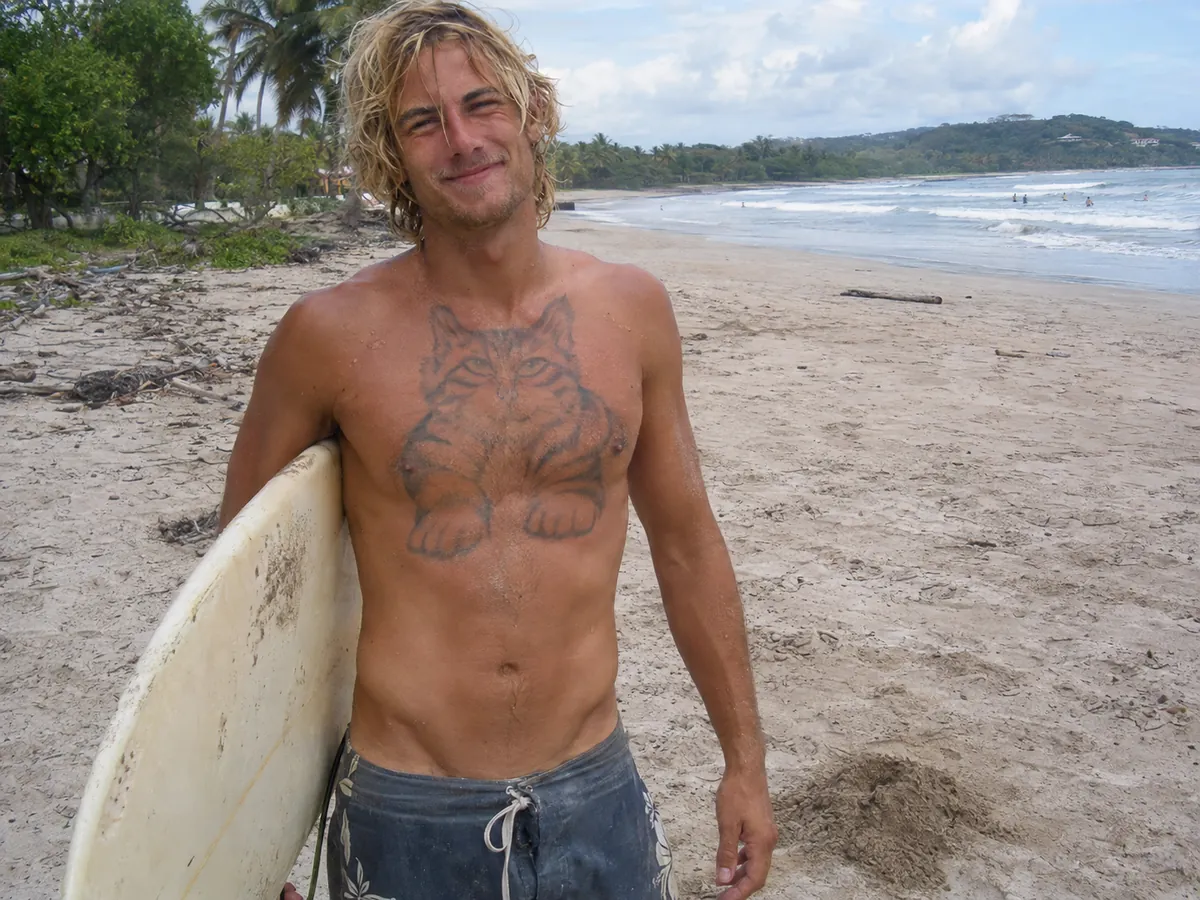
Scottie was a Canadian fisherman who worked four months a year and spent the other eight surfing someplace warm. I had taken three vacation days the previous year. Clearly one of us had misunderstood employment.
Scottie looked like somebody had ordered the lead singer of Nickelback and selected beach delivery. Across his chest was a large, deeply unfortunate tattoo of what appeared to be a tiger drawn from a description provided over the phone.
“What’s that?” I asked while pointing at Scottie’s chest.
“My cat, Suzy.”
“Oh. Did she die?”
“No, man. She’s back in BC. I just don’t get to see her much.”
He said this with such genuine affection that I felt bad for judging it. Somewhere in Canada, a perfectly nice cat had no idea she had a hideous tattoo in her honor.
I dropped my luggage in the room. Eddie handed me a surfboard, and we headed for the beach.
“Let’s get a little farther from the lagoon,” he said.
“Why?”
“Crocodiles.”
Scottie waved this off.
“I swam across yesterday. People don’t get eaten that often.”
I later heard that someone had been killed by a crocodile the week before. But maybe that meant we were safe for a while, because people weren’t eaten “that often.”
I was accustomed to swimming facilities where the acceptable frequency was never. But Scottie had already picked our surf spot and run ahead, satisfied that he had addressed my crocodile concerns.
Eddie stopped to bury his Adidas slides in the sand.
“So nobody takes them,” he explained. “Just remember where you put yours. I spent an hour looking for mine once.”
I buried my shoes. We had protected our twenty-dollar footwear. Then we set off into the crocodile ocean.
I had never surfed. Most of my experience with waves involved jumping over them in Florida while keeping an eye on our beach umbrella. Nevertheless, I attached the leash to my ankle and followed two experienced surfers into the Pacific.
Eddie and Scottie ducked neatly under the first breaking wave.
I held my board in front of me like a shield.
For a fraction of a second, I was Captain America.
Then the ocean hit me in the face with Captain America’s shield.
I tumbled through the water like Mary Lou Retton, bounced off the bottom, and came up considerably closer to where I had buried my shoes. Another wave was already on its way.
Eventually, after what felt like a full shift in an industrial washing machine, I reached the other two past the break. They were sitting on their boards, barely winded.
“These waves kinda suck,” Scottie said.
“Too choppy,” Eddie agreed.
I concentrated on breathing. It seemed rude to interrupt their disappointment with my medical situation.
We bobbed around for a while.
“Let’s go to Nicaragua tomorrow,” Eddie said. “The surf might be better. And I need to get my passport stamped.”
I had been in Costa Rica for approximately one afternoon. But apparently we were done with that country.
A fourth traveler
That evening, over Imperial beers, we met the fourth member of our expedition.
We did not invite a fourth member.
He arrived.
“You have to see these pictures!”
A shirtless, cherub-like French Canadian man set a laptop on the table and began showing us photographs of surfers. There was a surfer. Then another surfer. Then, in a bold departure, the first surfer again, slightly farther to the left.
This was Sylvain.
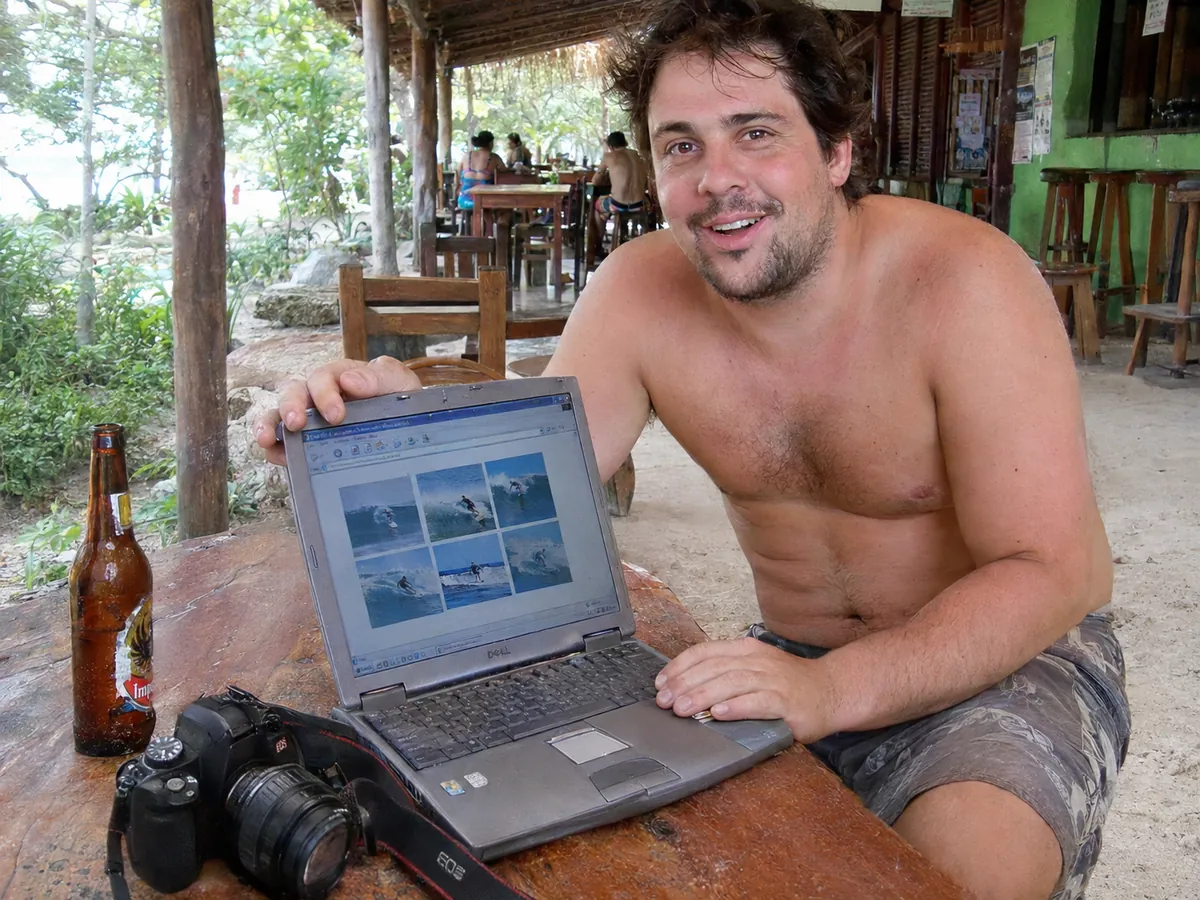
Sylvain was starting a surfing website. Eddie had somehow become involved, although from what I could tell, his duties were limited to receiving requests for money.
“I need another hundred and twenty for hosting,” Sylvain said.
“Can’t do it. We’re going to Nicaragua tomorrow.”
“Oh! I’ll come.”
Scottie looked up from his beer.
“With what money?”
“I still have sixty from the two hundred Eddie lent me.”
Eddie stared at him. Sylvain smiled. This appeared to be a well-established business relationship.
Scottie left to talk to some girls. Eddie and I stuck around for a few more pages of surfing photographs before going to bed, hoping Sylvain might forget about Nicaragua overnight.
Several hours later, my door swung open.
Scottie stood in the hallway with a woman tucked under his arm. They were both drunk, and the two of them seemed to be taking turns holding each other upright.
She introduced herself in Spanish. Scottie waited for her to finish.
“This is Maria.”
Despite spending months in Costa Rica, Scottie had learned almost no Spanish. He communicated through smiling, pointing, and having his shirt off. Maria seemed comfortable with the arrangement.
“Can we have the room?”
I was half asleep and wanted to be a good roommate, so I shuffled into the hall. Just before the door closed, a responsible thought managed to fight its way through.
“Wait. My bag.”
I retrieved my backpack. My passport was in there. Whatever else happened on this trip, I was going to keep track of my passport.
Then I spent the night in a hallway hammock under a buzzing light, using a pair of cargo shorts as a blanket.
In the morning, an older Costa Rican woman doing laundry woke me with her interpretation of Britney Spears.
“Hit me baby all the time.”
I lay there trying to work out whether the hammock had permanently changed the shape of my spine.
Maria slipped out of our room and gave me a friendly wave.
For four dollars, I had rented a bed for someone else’s date.
By the time we reached the morning bus stop to grab the Nicaragua Express, Scottie had recovered beautifully. He had his enormous surfboard, his backpack, and the cheerful expression of a man who had slept indoors.
Then he groaned.
Sylvain was coming down the road.
He remembered.
Man down
The bus cost something like 74 cents. I leaned my forehead against the window, hoping to make up some sleep following my night in the hammock.
The first pothole cured me of that idea. My head slammed into the window hard enough to kill a few billion brain cells.
We stopped periodically at gas stations so passengers could use the bathroom and buy snacks. A few minutes after one of these stops, Eddie turned around.
“Where’s Sylvain?”
His blue backpack occupied a seat a few rows behind us.
Sylvain did not.
Scottie started laughing.
“Did he get back on?” Eddie asked.
Nobody answered.
Scottie was now laughing hard enough that an answer would have required medical intervention.
None of us had a mobile phone to call him. The bus was not turning around. We had told Sylvain we were going to San Juan del Sur, but we had not mentioned a hotel because we had not bothered to pick a hotel.
Our meeting point was essentially Nicaragua.
“Maybe he’ll find us there,” I offered.
Even I could hear how stupid that sounded.
Eddie looked at Sylvain’s bag and sighed. Leaving the man behind had been an accident. Leaving his belongings behind would require a decision.
At the border, Eddie shouldered the extra backpack.
Scottie looked like Christmas had come early.
The border
The crossing was hot, dusty, and packed with trucks. Drivers argued. Engines idled. I followed Eddie through the confusion, paid what I understood to be a five-dollar fee, and tried to look like a person who knew which country he was currently standing in.
It turned out the five dollars was a line-skip fee. The truckers had opted to save the money and wait. We crossed a pedestrian bridge with gaps in the planks wide enough for a chubby toddler to slip through, and suddenly we were in Nicaragua.
On the other side, taxi drivers surrounded us. Eddie negotiated in Spanish while Scottie and I contributed nothing.
We were approaching a sixty-dollar agreement when an older European woman waved us over.
“I can take you for forty.”
She wore faded khaki and spoke with the reassuring authority of someone who knew where the clean towels were. Imagine Mary Poppins after a few months with Steve Irwin.
Behind her sat a Jeep Grand Cherokee.
I was considering whether getting into a stranger’s car at an international border was a good idea when Scottie began attaching his surfboard to the roof.
This was how our group made decisions. Eddie negotiated. I worried. Scottie loaded the vehicle.
The woman drove us toward San Juan del Sur, chatting happily while the road rearranged my internal organs. At one point, armed men appeared ahead of us. She offered a confident explanation about border enforcement, none of which I understood well enough to find reassuring.
Then they waved us through.
By the time she dropped us off, daylight was fading. Somewhere along the way, Eddie had settled on Bahía Majagual as our destination. We understood there was surfing and a resort we could stay at for the night.
“If you’re going out there, you’d better hurry to the dock,” our friendly British driver told us.
Then, with a “toodle-oo,” she drove away, leaving three men, four backpacks, and a surfboard in the dust.
At the waterfront, Eddie approached fishermen and asked about taking us up the coast. One shook his head. Another laughed. Eddie increased his offer.
The answers did not improve.
Finally, he came back.
“They say it’s too dangerous at night.”
He sounded annoyed, as though the ocean were using surge pricing.
Personally, I felt that when Nicaraguan fishermen refused a large sum of money to take you on their boat, you should probably listen to them.
We headed back into town to figure out where to sleep. Morale was low. We had no idea where we were going.
Up ahead, a man wandered into the street, reconsidered, and wandered back. He also appeared to be lost.
Eddie stopped.
“Is that Sylvain?”
“No,” Scottie said immediately. “It can’t be…”
It was absolutely Sylvain.
We watched him dodge another passing car. There was still time to turn and run. I could feel all three of us considering it.
Then he spotted us.
“Hey, guys!”
He walked over as though we’d briefly split up at the mall, took his backpack from Eddie, and asked to borrow a hundred dollars.
He had spent everything reaching town.
Eddie handed him a couple of twenties.
We had abandoned Sylvain at a gas station in another country, with no phone and no meeting point, and he had still managed to find Eddie’s wallet.
The road to Bahía Majagual
We were standing around with no plan when a Honda Civic pulled up.
This Civic had exhausted whatever life Honda originally intended for it and was continuing out of spite. Somebody had added a giant spoiler and an exhaust loud enough to announce problems the engine hadn’t developed yet.
The driver looked fourteen.
I don’t know how old he actually was. I do know that if he’d been riding a bicycle through my neighborhood, I would have asked where his helmet was.
“You go Bahía Majagual?”
Eddie leaned toward the window.
Apparently there was a way to reach it overland. We had been operating under the impression that it was an island, which gives you an idea of our degree of travel research.
The driver’s passenger looked at the four of us. Then at the luggage. Then at Scottie’s surfboard.
“We’re not all fitting in there,” Scottie said.
Then he looked scornfully at Sylvain.
“One too many.”
The driver exchanged a few words with his friend, who suddenly got out and ran off into the dark. Scottie immediately began securing his board.
Decision made.
We squeezed in. The car settled several inches closer to the earth.
For a little while, things went surprisingly well. We climbed a paved hill. The engine sounded unhappy, but it continued moving. It chugged along with a misfire that seemed to be saying, “I think I can, I think I can, I think I can.” Maybe we had been too quick to judge this young entrepreneur and his little Civic that could.
At the top, he turned off the road.
Into a dry creek bed.
The first impact came up through the floor and into my teeth.
We lurched forward. Scraped. Stopped.
“Everybody out.”
We got out and pushed the Honda over the first of many rocks.
Somehow this was now a service we were providing.
The stereo, easily the healthiest component of the vehicle, blasted “Total Eclipse of the Heart.” Our driver loved it. He glanced back at us with a grin, clearly expecting shared enthusiasm.
I tried to smile while bracing for the next collision.
Bonnie Tyler was giving everything she had. So was the oil pan.
For the next half hour or so, we bounced down the creek bed, occasionally getting out to help our taxi remain a taxi. Nobody had much to say. We focused on helping the Civic survive the night.
Then we saw lights.
Buildings. People. An actual place.
I felt an almost embarrassing rush of affection for our driver. He had done it. The ridiculous little car had delivered us.
We paid him forty dollars, unloaded, and watched the taillights bounce away up the hill.
Then we turned toward the entrance.
CLOSED FOR PRIVATE EVENT.
Behind the sign, people were having what sounded like an excellent time.
For a moment, we just stood there with our bags.
Then we started walking down the beach.
Beaches had hotels, right? Every Florida beach I had been to was littered with hotels, motels, and Holiday Inns.
This one appeared to have opted out. The beach was empty and dark as far as we could see.
New friends
We stumbled through the dark until a fire appeared ahead of us.
Around it were people, tents, and a small house. After the last several hours, this qualified as a resort.
A Nicaraguan woman answered our knock. She had two tents available for two dollars apiece. She also had a room for ten dollars.
“I’ll take the room,” I said.
Eddie looked at me as though I had requested the presidential suite.
I didn’t care. I had spent the previous night sleeping under my cargo shorts.
“I need the room too,” Sylvain announced. “I need a shower.”
Eddie gave him a long look. There is something especially irritating about watching someone upgrade his accommodations with your money.
But the arrangements were made. Eddie and Scottie took the tents. Sylvain and I went inside.
Our room for the night was the owner’s little girl’s bedroom.
Two tiny beds. Pink bedding. Unicorns and rainbows on the walls.
I set my backpack down beside a bed designed for somebody who might still believe in the Tooth Fairy. Sylvain began settling in on the other side.
But we couldn’t sleep yet. We were starving.
When we asked our Nicaraguan host about a restaurant, the woman laughed, then offered to take us to a neighbor’s “shop.”
I pictured shelves. Refrigerators. Perhaps a deli counter. Some exhausted, optimistic part of my brain was planning out the toppings for my Publix chicken tender sub.
After a long walk in the dark, she led us into another small house and showed us the food they had for sale.
There was spaghetti.
There was no pasta sauce.
“Get the ketchup,” Eddie said.
I looked at him.
“It’s tomatoes.”
Anthony Bourdain traveled to unfamiliar places and discovered the soul of a culture through its food. I had traveled to Nicaragua to learn that my friend would put ketchup on spaghetti when he was starving.
Back at the fire, we attempted to boil water and chatted with our tent neighbors.
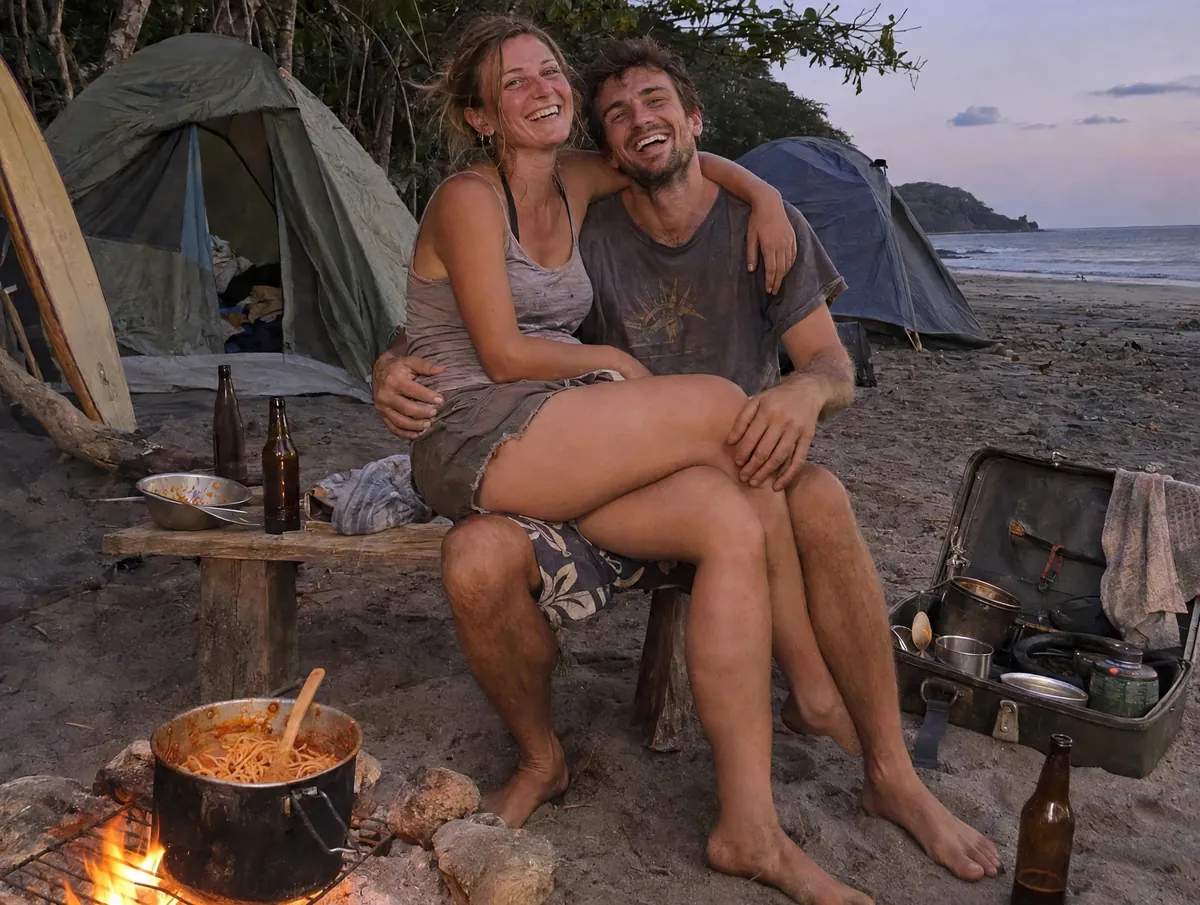
Olga and Dimitry were an overly affectionate Eastern European couple who had been traveling for about a year. Olga sat in Dimitry’s lap with the permanence of a seatbelt. If he had stood up, I suspect she would have gone with him.
“This is our last week,” she said. “Not much left on the card.”
She held up a credit card and looked at it sadly.
“That sucks,” I said. “Coming home and having to pay all that off.”
They both laughed.
“No,” Olga said. “Fake names. We don’t pay.”
Before I could process this new approach to vacation financing, Scottie came hurtling down a nearby dune.
He was sweaty and breathing hard.
“They’re after me.”
He said it quietly, which somehow made it worse.
“Who?” Sylvain asked.
Scottie looked irritated that Sylvain was participating in his emergency.
“The guy at the resort.”
While we were buying dinner, Scottie had gone back to the private party. According to Scottie, he had charmed his way in and was doing Goldschläger shots with the owner.
“I was trying to get you guys invited.”
Of course. Scottie was on a humanitarian mission.
Then the owner dropped the bottle. It shattered, and Scottie made a joke about cutting him off.
The owner responded like Ike Turner after learning Tina finished off the cocaine. He reached behind the counter for his Louisville Slugger while yelling obscenities at Scottie.
“Shh.”
We all stopped and listened.
The fire crackled. The ocean rolled in. Nothing with a bat emerged from the bushes.
Scottie started to relax. Then he started going through my backpack.
“What are you doing?”
“I left it in your sock.”
He pulled out the weed.
“You put that in my bag?”
“Yeah.”
“I carried that across the border.”
“Calm down. If they were going to search anybody, it would’ve been me.”
He gestured at his hair and tattoos, including the mangled likeness of Suzy on his chest.
For reasons I am still unable to explain, he considered this a defense.
“I was going to put it in Sylvain’s bag,” he added. “But then we lost him.”
I was his backup drug mule.
I felt somewhat offended that I wasn’t even his first choice.
He offered me some. I declined. I have never particularly liked weed, and discovering I had unknowingly participated in the international drug trade did not improve my opinion.
The other campers were more enthusiastic. People drifted toward the fire. A short Israeli guy named Ari brought over a cooler of Victoria beers.
Dimitry examined our spaghetti and ketchup with the expression it deserved, then took over.
Out came cooking gear, spices, cheese, and sausages. Other people contributed things from their tents. The sad pot of noodles turned into an actual dinner.
We passed food around the fire, balancing plates on our knees. Everyone had a story about where they’d been or where they were going, and nobody seemed particularly troubled by the fact that the four of us had just arrived without somewhere to sleep or anything decent to eat.
For the first time all day, I stopped wondering what the next problem would be.
The food was good. The beer was cold. Beyond the fire, I could hear the surf I’d spent so much money and effort failing to ride.
A few days earlier, I had been sitting under fluorescent lights, watching vacation days disappear. Now I was barefoot on a beach, eating dinner with people I hadn’t known an hour ago.
At that moment, I may even have forgiven Scottie. Partially.
Then a military truck rolled into camp.
Discotheque time!
“I got us a ride!” Olga announced.
“A ride where?” Eddie asked.
“The discotheque!”
Scottie was already climbing aboard.
Apparently being chased out of one party with a baseball bat had only fueled his desire to make it a successful night.
The vehicle was a huge military-style deuce-and-a-half truck with an open bed. I had no idea how Olga had arranged it. Given her explanation of the credit cards, I wasn’t sure I wanted the full details.
Eddie and I grabbed road beers and climbed in with the others. Sylvain had already gone to bed, having completed another exhausting day of being transported and financed.
About fifteen of us crowded into the back as the truck started up the same creek bed that had nearly consumed the Civic just hours ago.
Then it began to rain.
Not a shower. The sky emptied.
Within seconds, my clothes were soaked through. Water ran down my face and into my beer. The dry creek below us began turning into an actual creek.
The truck kept climbing.
I held on to the side and watched water move around the tires. The little Civic would have been underwater. Nothing fazed the truck.
Somewhere around halfway up, I decided we were too quiet. The situation needed some Kenny Rogers. I began singing “The Gambler.”
Eddie turned toward me.
He knew what happened when I started singing. Country music was just the entry point. Eventually, we would arrive at Disney or Backstreet Boys.
But he couldn’t stop me in time. The others joined in. Tentatively at first, then loudly. International travelers who had struggled to understand each other’s thick accents earlier around the fire suddenly possessed an amazing knowledge of Kenny Rogers lyrics.
By the chorus, we were shouting over the rain, a truckload of drenched strangers offering one another advice about knowing when to walk away.
When the song ended, people laughed and cheered.
I looked directly at Eddie and started “A Whole New World.”
He closed his eyes.
The others joined in.
We arrived at the club soaked, grinning, and dressed like the evacuation of a beach volleyball tournament.
Outside, men in dark fatigues held big guns. Shotguns, M16s, and other gun names that gun people would know.
Scottie surveyed them approvingly.
“Good security.”
I admired the consistency. Crocodiles meant the swimming was probably fine. Armed guards meant the nightclub was safe.
Inside, the DJ was blasting a 50 Cent remix.
Scottie immediately disappeared toward some local women. Eddie and I discovered that fifteen dollars would buy us bottle service, including local vodka and a seemingly endless supply of Red Bull.
Fifteen dollars.
At home, we were a teacher and a junior CNN employee. Here, we were high rollers with bottle service and a VIP table.
We had spent the day hunting for two-dollar beds. Fifteen dollars seemed reasonable to cosplay someone wealthy and important.
Eventually, the club thinned out, and Olga and Dimitry began collecting everybody for the trip back. Scottie objected on the grounds that there were still women inside.
Then we realized Ari was missing.
We searched the club. Asked around. Waited.
Nothing.
Eventually, we climbed back into the truck without him.
There was no singing on the return trip. I kept looking at the empty space where Ari should have been, wondering whether we had left too soon.
Losing Sylvain had seemed funny because Sylvain had reappeared.
But losing Ari seemed like a tragedy.
Back at camp, I crawled into my little pink bed. Sylvain was snoring. My feet extended farther than the bed’s designer had intended.
I slept anyway.
Guess who’s back—back again?
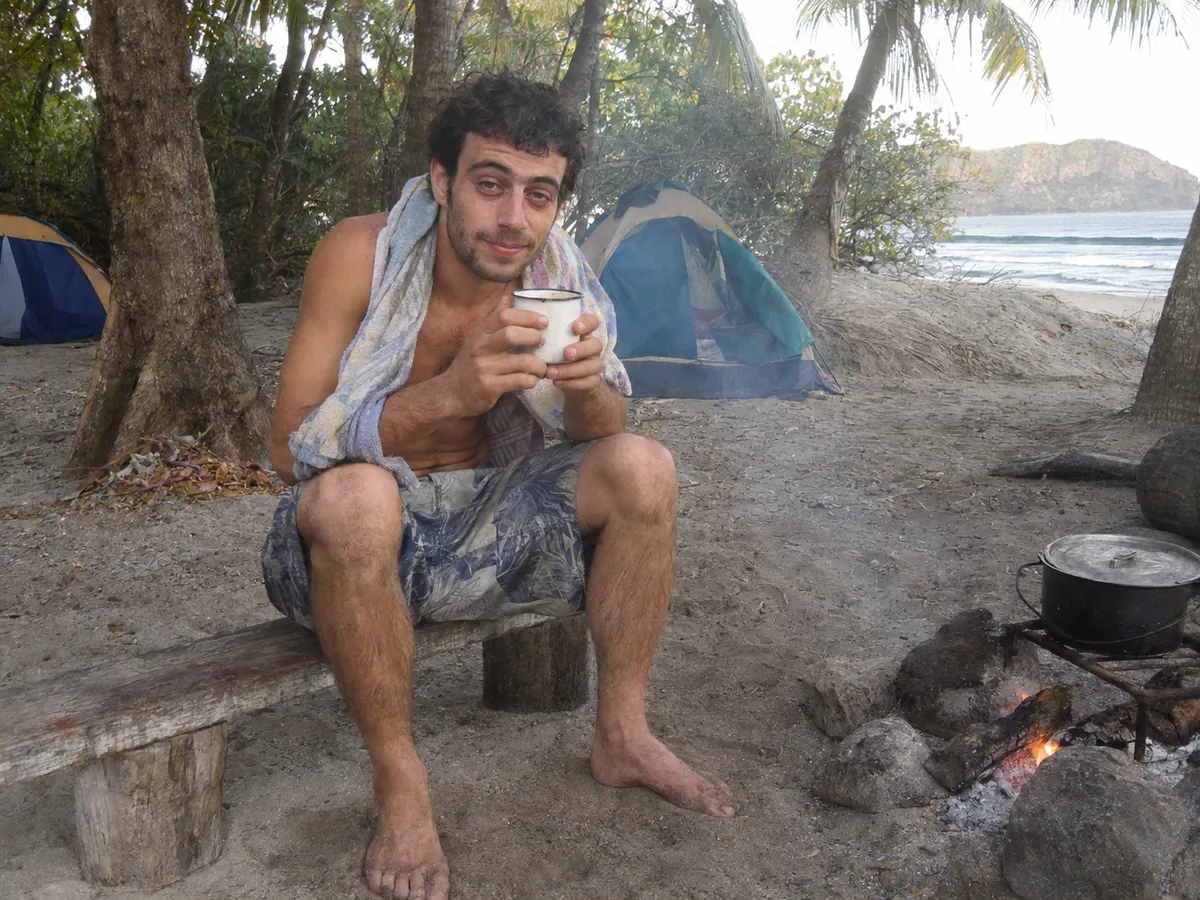
When I woke, Dimitry was cooking breakfast over a fresh fire.
I sat down with a cup of coffee and was beginning to feel human when a figure appeared on a nearby dune.
Shirtless. Hunched over. Moving carefully.
“Ari!” Olga shouted.
She ran to him.
“Where were you?”
He looked at us.
“They took my shoes.”
He was barefoot, shaking, and exhausted. We helped him over to the fire.
As he warmed up, we got the story. He had gone skinny-dipping with a couple of girls near the club. When he came out, his clothes, shoes, wallet, and passport were gone.
He couldn’t find us. He had no money for a ride.
So he walked back along the beach.
All night. Ten kilometers, barefoot, in the dark.
“What are you going to do?” Eddie asked Ari.
Ari shrugged.
“Get to the consulate in Managua. Get a passport. Go home.”
We sat with that for a minute.
I looked down at my own sandals.
“You gotta remember to bury your shoes,” Eddie offered.
Then Scottie spoke.
“We should go too. The surf here isn’t that great.”
Of course it wasn’t.
The waves had once again failed to meet Scottie’s exacting standards.
He knew a place on Ometepe, an island in Lake Nicaragua. Surfing had apparently slipped down the list of priorities. We could travel with Ari for part of the way, then head for the island.
I suspected Scottie’s enthusiasm also had something to do with the nearby resort owner and his baseball bat. Still, an island in a lake sounded like a pretty good plan.
We packed our bags and said goodbye to the people around the fire. Olga and Dimitry stayed behind to enjoy whatever remained of somebody else’s credit limit. Ari came with us. Sylvain, naturally, was ready to go as soon as Eddie lent him a few more bucks.
We never did get to stay at the Bahía Majagual resort. Ometepe was next. I climbed onto the bus with the others.
But not before I opened my backpack and checked every sock.
To be continued.