
Claire and I woke up at 3 a.m. Sunday morning to explosions outside, which is generally not how you want to start a relaxing winter weekend.
It was still pitch black. Thick clouds covered the moon, and heavy freezing rain was pounding the roof in that deeply comforting way that says, “Something expensive is probably happening soon.”
Then our backyard lit up orange.
There was a fire about 40 feet in the air.
For a few seconds, we just stared at it, because your brain does not immediately have a folder labeled “sky fire.” Eventually we realized trees were leaning onto the high-voltage lines near our house and sparking fires.
Claire called 911. They picked up quickly, which was encouraging. The actual words were less encouraging.
“I’ll alert the fire department,” the operator said. “There’s another fire on Knob Road nearby, so maybe they’ll be able to check on yours as well.”
Maybe.
That is not the word you want to hear when fire is suspended above your backyard like a Cirque du Soleil routine sponsored by Nashville Electric Service.
The fire department never made it to our house, but the fire eventually burned itself out. As we watched it fade, strange green flashes lit up the sky in the distance. Earth-shaking booms continued all around us.
We decided the green flashes were probably transformers exploding across Nashville, and the booms were giant trees falling.
This was not based on expert analysis. It was based on being awake at 3 a.m. during the apocalypse and trying to remain calm.
Rain continued through the next day. The temperature hovered around 32 degrees, which is the worst possible weather number. If it’s 20, you know you’re frozen. If it’s 45, you know you’re wet. But 32 just sits there like a sadistic middle manager making everything worse.
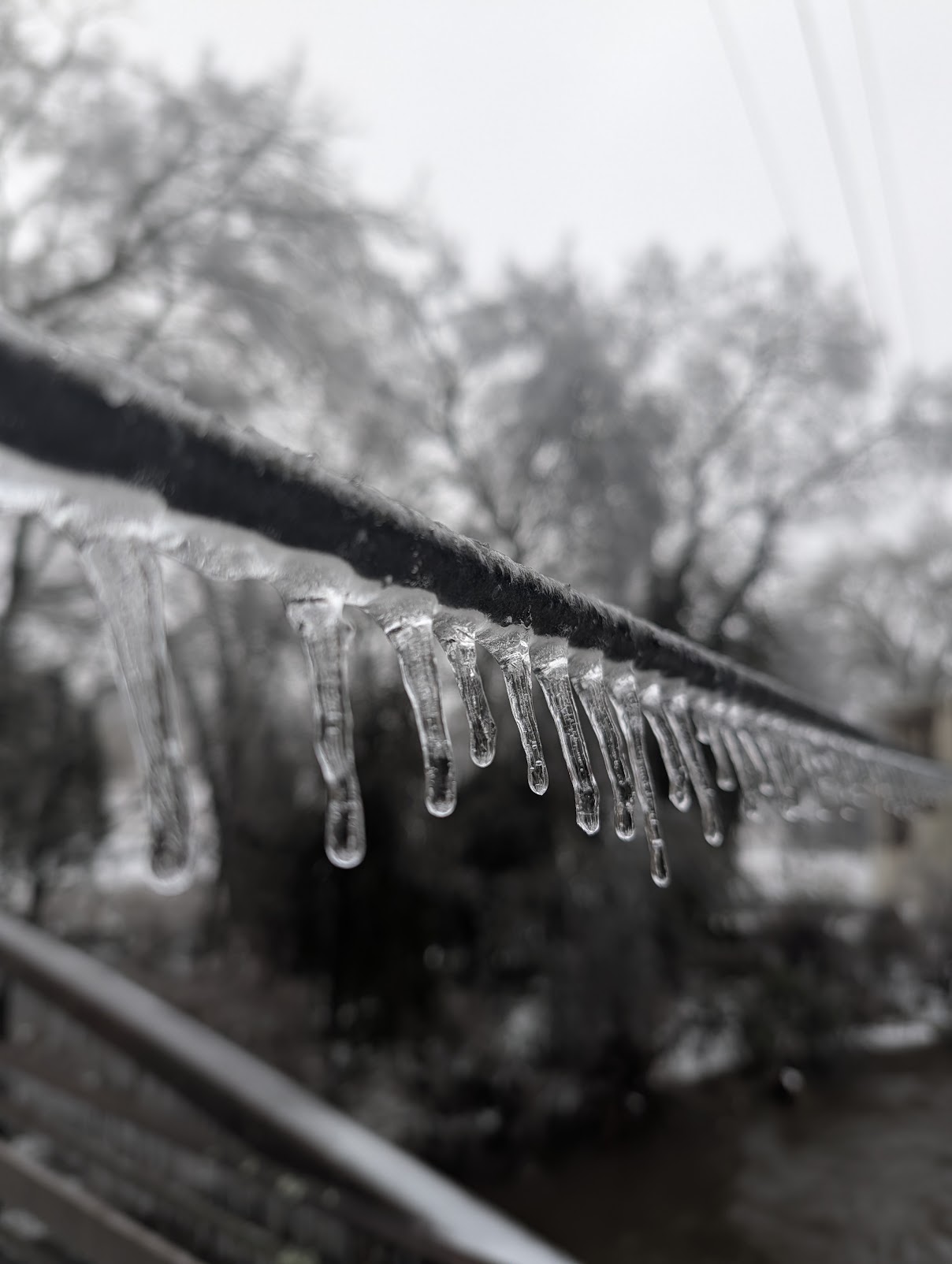
I kept checking the icicles on our back porch to see if they were growing, because apparently that was my new hobby.
The news showed power outages spreading across the city.
“It’s up to 120,000 homes in Nashville,” someone on TV said. “That’s a quarter of the city.”
The kids were excited to be out of school, because kids do not understand infrastructure collapse. Parker spent most of the day in VR on his Meta Quest, and Audrey watched an amount of YouTube Kids that would probably get us flagged by child welfare.
Around noon, our neighborhood lost power.
At first, I wasn’t too worried. We live in a developed part of central Nashville. Power outages here usually last a few minutes. You reset a clock, complain about NES, and move on with your privileged little life.
So naturally, I decided to go for a walk.
The neighborhood looked awful. Our cul-de-sac was already inaccessible because of ice, and now it was blocked by a downed hackberry tree. Huge limbs and chunks of ice were actively falling everywhere. The big beautiful oaks along Richland Creek Greenway, normally the kind of trees that make you appreciate urban nature, had transformed into giant wooden murder machines.
I walked around them like they were drunk guys outside a bar at 2 a.m. — respectfully, cautiously, and with no interest in making eye contact.
When I got home, the power was still out, and Claire was worried.
This is when I reluctantly became Generator Guy.
Claire had pushed me to buy a generator years ago. I had always been annoyed that we dragged it with us through multiple moves without using it once. It was one of those purchases that sits around forever making you feel both prepared and stupid.
Unfortunately for my pride, Claire was right.
I shut off the main breaker and hauled our small generator to the back patio.
I had already prepared the parts for a very sketchy male-to-male extension cord to backfeed the furnace, which is commonly called a “suicide cord” because apparently subtlety is dead. I had avoided actually assembling it because I did not want a dangerous homemade electrocution rope sitting around the house.
For the record: this is not a recommendation. Backfeeding a house without proper transfer equipment is dangerous and can hurt or kill utility workers, homeowners, and anyone else unlucky enough to be involved. This was very much a desperate emergency situation, not a YouTube tutorial.
That said, setting it up went remarkably smoothly. I plugged the generator into a covered exterior 15-amp outlet on the patio. When I fired it up, half the lights and outlets in the house came on, along with one of our two furnaces.
I started turning off everything I could to reduce the load. Our generator could only output 15 amps, and the outlet was on a 15-amp breaker. So the system was basically powered by math, hope, and the confidence of a man who has made several questionable electrical decisions in his life and lived to tell about them.
After some trial and error, we figured out we could run the furnace or the refrigerator, but not both.
We chose heat.
The food in the fridge had been purchased right before the storm, because of course it had. We had fully stocked up for the kind of winter storm where you eat chili and watch movies, not the kind where your house turns into a refrigerated cave and the city runs out of gasoline.
We couldn’t cook anything anyway because we have an electric stove. So we threw away a bunch of food and entered the peanut butter sandwich phase of the disaster.
I checked the cameras at my rental houses and saw that two of them also appeared to have lost power. Fortunately, one was unoccupied, and our friend Raiane lived in the other. We had already invited her to stay with us if things got bad.
Then things got bad.
Temperatures were expected to drop to 14 degrees that night and zero the following evening. I started worrying about frozen pipes at the houses with no heat.
So I bundled up, packed a backpack full of tools, and headed out on foot.
I ended up walking an eight-mile loop around West Nashville, checking houses one by one. The damage was shocking. Nearly every neighborhood house had some combination of downed trees, roof damage, smashed cars, or giant limbs scattered across the yard like God had gotten really into Jenga.
There were power lines lying across roads. I gave them a wide berth because I am dumb enough to make a generator cord but not dumb enough to play jump rope with live electrical infrastructure.
No one was out. The ice-covered roads were empty, which made the whole city feel abandoned. It was quiet except for the cracking of trees, the dripping of ice, and the occasional distant boom reminding you that somewhere nearby another large object had lost its battle with gravity.
Thankfully, none of my houses had major structural damage. One had large limbs down in the front and back yard, but nothing seemed to have hit the house itself.
At each property without power, I used a wrench to turn off the water main and drained the pipes through an exterior faucet. At one house, the water meter was under about two feet of water. I rolled up my sleeves and reached down into it, which was a special kind of unpleasant. Luckily, the water was clear, so I found the shutoff quickly.
There was still a risk of toilets and water heaters freezing, but I had done what I could.
As I was leaving Raiane’s house, I ran into her neighbor Edward, a plumber who was also shutting off his water.
We chatted for a minute. Then, suddenly, a 100-foot tree collapsed into the road beside us.
I thanked Edward for slowing me down, because if he hadn’t stopped me to talk, I might have been closer when it fell.
This is the kind of thing that makes you reconsider every time you’ve ever tried to avoid small talk.
On my way home, I walked through Charlotte Park and looked at the thick ice covering the jungle gym, swings, and basketball court. By the time I got home, I was exhausted, but grateful to return to a warm-ish house.
Warm-ish became the official standard.
Not warm. Not comfortable. Warm-ish.
Other neighbors weren’t so lucky. Some were already leaving for hotels, including a family with a one-month-old baby. By Tuesday, almost everyone on our street had left. Indoor temperatures in many homes were hovering just above freezing, which is great if you are a head of lettuce and less great if you are a human family.
Working remotely Monday and Tuesday was a challenge. Raiane was able to watch Audrey, which helped a ton, but I still had to make frequent trips to the gas station for generator fuel and to grocery stores for food that did not require cooking.
We survived mostly on cereal, bagels, and peanut butter sandwiches. It was like a college diet, but with fewer Natural Lights.
Tuesday was Parker’s birthday.
We had already canceled his airsoft party. He was excited to get a new 3D printer, but we couldn’t turn it on because it drew too much power. This felt like a pretty accurate summary of the week: here is your exciting new technology, son, but unfortunately civilization is temporarily unavailable.
Claire and Raiane made “snow ice cream” instead of birthday cake. It came out more like ice cream soup, but it still tasted good.
Eventually, Claire found a room at the Gaylord Opryland Hotel. She took Audrey and headed there, where the powerless time could be spent at SoundWaves Water Park instead of inside a dark house turning into a meat locker.
I stayed behind with Parker to keep the generator running and watch the dog and cat.
Tuesday evening, I walked to the gas station to top off the generator before bed and found a sign on the door:
“No gas or propane.”
The pump handles had plastic bags over them.
I asked the cashier what happened, and he said they had simply run out. He didn’t expect another delivery for two to four days.
Two to four days.
I tried other nearby stations and got the same result. Everyone was out of gas.
This was when I briefly researched how to siphon gas from a 2020 Chrysler Pacifica and learned that modern cars have anti-siphon tanks.
Great.
Apparently automakers had considered the possibility that desperate dads might try to extract minivan fuel during an ice storm and decided to ruin that too.
That night, I heated the house as much as possible and shut off the generator before bed. Wednesday morning was cold, but the house had held heat surprisingly well. I searched online and found a Home Depot that reportedly had gas cans in stock. I needed something bigger than my two-gallon tank, which now felt less like an emergency fuel supply and more like a child’s beach toy.
By the time I arrived, the store had been mostly picked clean, but I found one five-gallon gas can.
I also saw a few generators on the floor, but they disappeared faster than a Black Friday doorbuster. I half expected to see two grown men fight over one in the aisle while a Home Depot employee quietly reconsidered every life decision that led him to that moment.
After Home Depot, I stopped at Taco Bell and had my first hot food in days.
The cantina chicken burrito and soft taco were glorious.
Gas was still hard to find, but now that I was driving instead of walking, I could get farther out. I eventually drove about 10 miles outside the city and found a station with Super Premium in stock.
We ended up going nearly nine days without power.
Nine days is a long time to live in the middle of a major American city while operating your home like a campsite with walls.
Claire and Audrey spent much of the outage at Gaylord Opryland, where Audrey got to play at SoundWaves and experience the storm as more of an unexpected hotel vacation. Parker and I stayed at the house, keeping the generator going, watching the animals, checking pipes, rationing electricity, and enjoying the ambience of one furnace, partial lighting, and constant low-grade anxiety.
The power finally came back after nine days.
And when it did, it felt almost suspicious.
Lights turned on. The furnace worked. Outlets became outlets again instead of precious magical portals that had to be carefully negotiated with a generator. The fridge could run without me choosing between cold milk and warm children. The house made normal house sounds again.
It was incredible how quickly everything went from survival mode back to normal.
But that was also the unsettling part.
Because for nine days, normal had been gone.
We were lucky. We had a generator. We had water. We had some heat. We had a place for Claire and Audrey to go. We had enough tools, stubbornness, and bad ideas to keep the house from freezing. Plenty of people had less.
The storm was destructive, no question. Trees came down everywhere. Lines were crushed. Crews had a massive job in brutal conditions.
But once Nashville thawed out, it was hard not to wonder how so much of the city became that vulnerable that quickly. How a central neighborhood could empty into hotels. How gas stations could run dry. How families with babies could be pushed out of their homes. How a city like Nashville could feel, for a few days, like the grid was less of a system and more of a suggestion.
I’m glad the power is back.
I’m glad Claire was right about the generator.
I’m glad Parker will eventually get to use his 3D printer.
And I’m very glad Taco Bell stayed open.
But after nine days of living by extension cords, gas cans, and weather forecasts, I have one question that I suspect a lot of Nashville will be asking for a while:
How did this happen here?